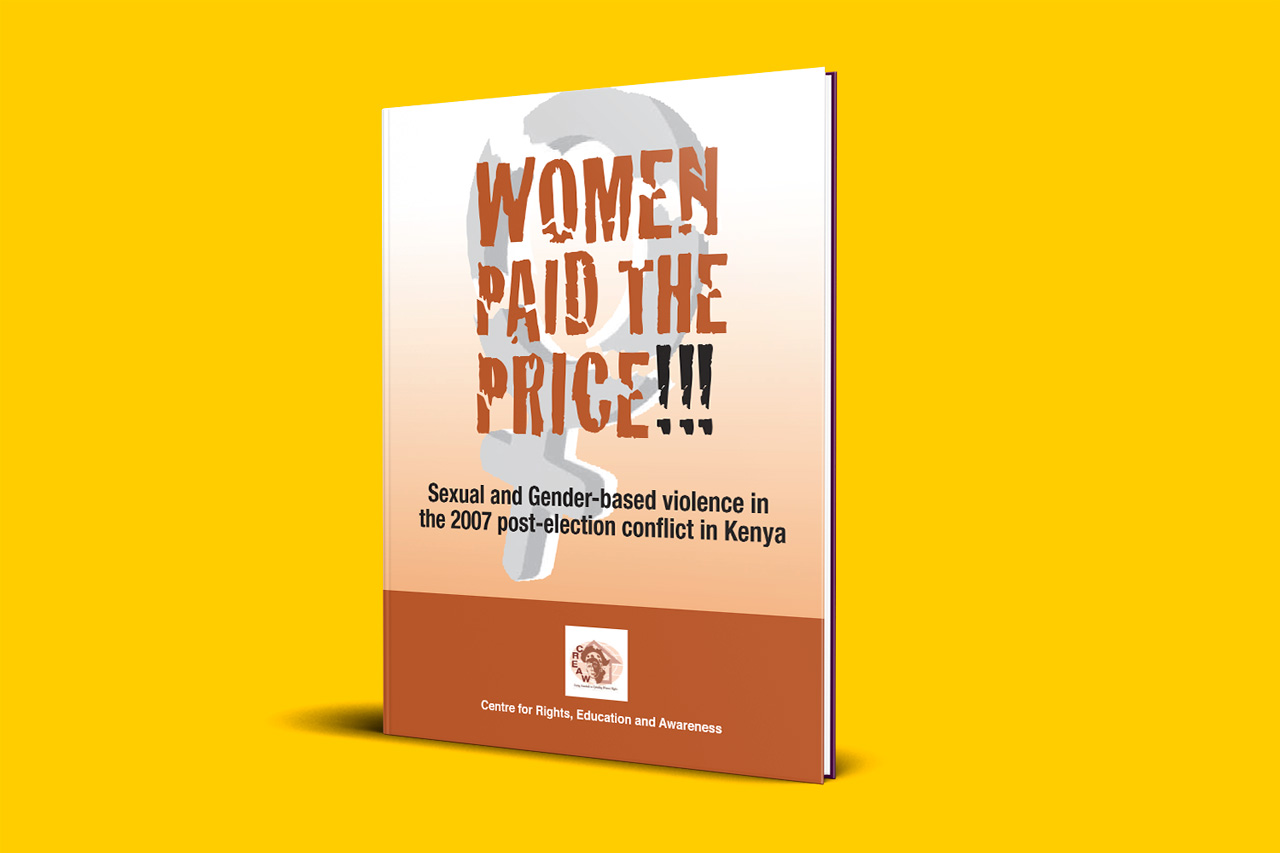
Between December 2007 and March 2008, Kenya faced its worst political and governance crisis yet. Unlike in the previous general elections since 1992 when the ruling Party used politically motivated violence to diminish the vote of their competing Political Parties in the opposition as a strategy of rigging, this post election violence went beyond the control of the political system and degenerated to a state of total break down of Law and order. Three months of a political stalemate fertilized by the contested presidential election results, undermined the foundation of the nation, the economy and extensively created a climate for the violation of citizens’ rights. It is in that context that the most despicable sexual and gender based violence in Kenya’s post independence history were witnessed. This is the context within which women paid the price of a failed state, an incompetent government and the culture of violence in the Kenyan society.
The constitution failed the people of Kenya. Kenya’s constitution has always failed to cover the nakedness of all the citizens and only padded and secured the comfort and security of a few privileged citizens. The constitution has established a government that is unresponsive to the rights of the poor and the majority of the weak citizens who are mainly women, the youth and children. This enduring legacy has created and fertilized a culture of impunity, the abuse and disregard of the institutions of the state, lack of accountability and a culture that disregards international norms and standards of governance and Human rights protection and promotion. From this cultural context, the politics of exclusion have taken root. Kenya’s politics of exclusion are powered by the winner takes-it-all, first-past-the-post electoral system that makes elections a life and death affair where the losers also lose all in the political system. This paradigm has been legitimized
by Kenya’s expired one-Party- state constitution that has failed the interests of Kenyans but promoted the interests of the ruling class, particularly those in the ruling party and in public office.
The current constitution arrangement has engendered the capture and instrumentalization of state institutions by the elite. State institutions like the Cabinet, parliament, the Judiciary, the police force, the military as well as other social institutions such as the media and religious organizations have since independence come under the total and stifling elite capture. The outcome of this elite capture of state institutions is a fractured political and social system that is completely incapable of effectively governing the state and nation. State institutions are neither neutral nor competent to govern and are therefore largely resented by the public and its officials; who are seen as a new breed of occupying forces who are far removed from the struggles of the masses of the people.
That is how the Electoral Commission of Kenya collapsed under the pressure of the dominant political actors and failed to deliver on a basic responsibility of faithfully reflecting the will of the people that had been expressed through the vote. The Electoral commission was rendered hopeless and its constitutional mandate executed under the direction of the executive.