
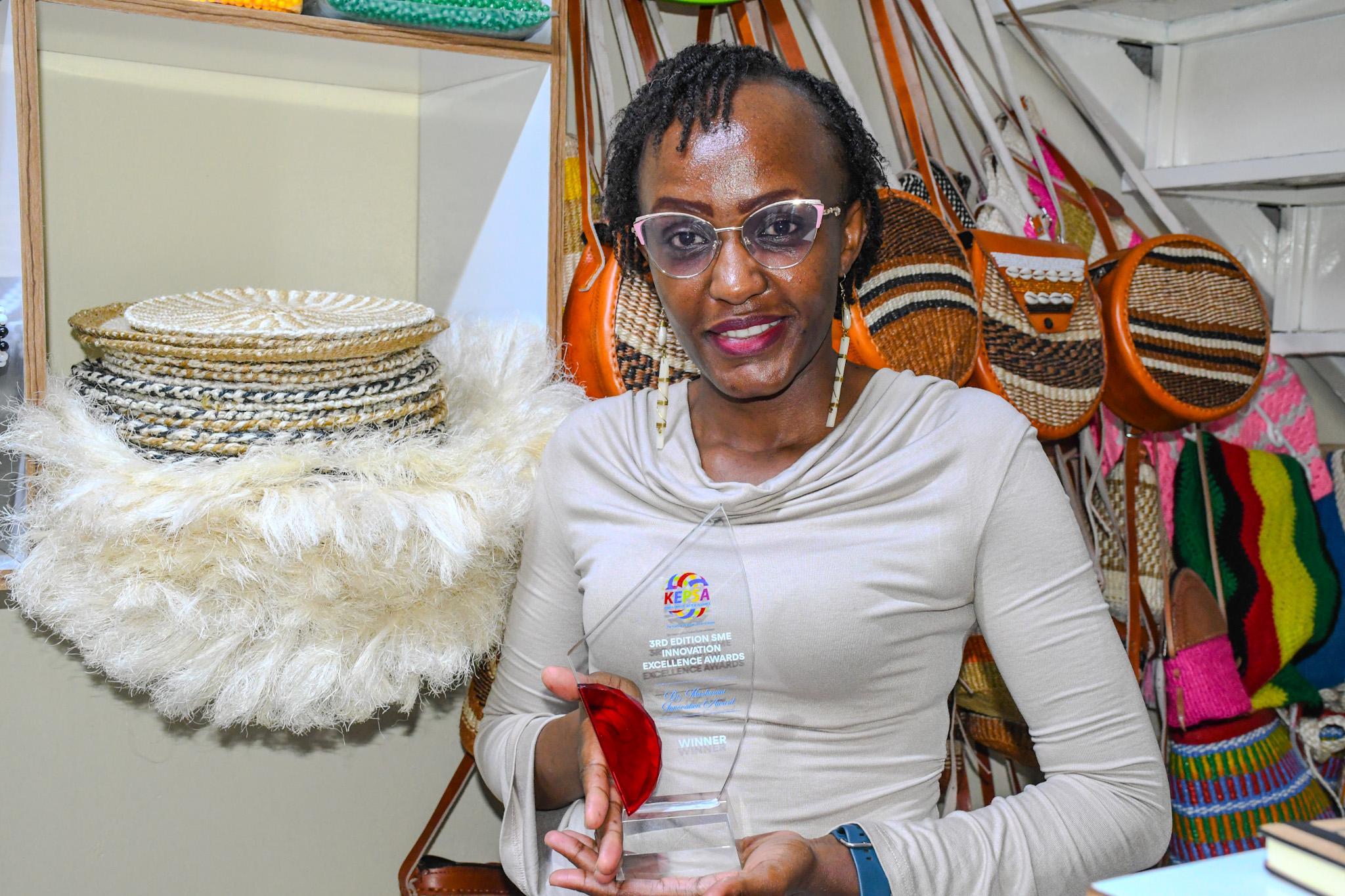
In the bustling town of Meru, we weave our way through a row of busy shops before reaching one filled with vibrant beadwork, exquisite handmade jewellery and colourful party décor. The shop has a sunken floor, giving us a bird’s-eye view of the space. Standing at its centre is Winnie Nkirote, whose warmth seems much bigger than her small frame. Her smile and effusive welcome make us feel instantly at home. Her face, however, gives little away about the hardships she has endured. At 34, Nkirote describes the past few years as one of the toughest seasons of her life.
In 2022, following experiences of gender-based violence (GBV), she left her marriage with a baby who was only a few months old. She had to start over with nothing but the clothes on her back, at a time when the country was also navigating the economic uncertainty surrounding an election year. For a while, Nkirote lived hand to mouth. Her son suffered from severe eczema that required constant medical attention and supplies. There were times she skipped meals so she could afford the care he needed. As bills piled up, the pressure began to take a toll on her mental health. Her saving grace was her creativity and an unwavering determination to keep trying.
She began making beaded items, including intricate steering-wheel covers, while also baking cakes to order using a traditional jiko. She did all this from home as she cared for her young son. Leaving him with a caregiver or at a daycare facility was not an option. His eczema often caused him severe discomfort and frequent crying, making it difficult for Nkirote to leave him for long periods. The situation limited her ability to increase production, take on more orders and grow her business.
In 2025, Nkirote was referred to the Jasiri Program through a CREAW community champion. Her journey began with something she desperately needed: support to heal. She enrolled for counselling, which she says helped ground her.
“I honestly felt like I was losing it. I had so much trauma and I had no way of processing it,” she says. “The counsellor was so patient and, seeing that I needed further support, connected me to a trauma counsellor, all for free.”
As she continued her healing journey, Nkirote also enrolled in financial literacy classes through the program. For her, the sessions offered practical knowledge that she could immediately apply to her growing business.
“In my business plan, I indicated that I wanted to buy a commercial mixer, steamer and essential baking supplies so that I could bake more and make better quality cakes. When the grant of Ksh 25,000 came in, that’s exactly what I did,” she recalls.
The new equipment changed the pace of her business. It increased her productivity while freeing up time for her to make more beadwork. As demand for her cakes grew, Nkirote noticed another opportunity. Many of her customers were looking for event décor and setup services. She began supplying event décor and eventually expanded into setting up the décor herself. What started as an additional service became a new revenue stream and helped grow her brand.
Armed with the financial literacy skills she had gained, Nkirote also turned to social media to market her products and services. But she noticed that many potential customers were hesitant to buy from a business without a physical location. Owning a shop therefore became her next goal. In early 2026, Nkirote qualified for a Ksh 100,000 loan through the Jasiri Program and she knew exactly what she wanted to do with it.
“I took only five days to set up my shop from the day I received the money. In that short time, I was able to get a shop, pay the deposit and rent, and get a fundi to set up the shelves. I had no time to waste,” she says with a laugh.
The timing could not have been better. Her son had just started school, and for the first time in years, Nkirote had somewhere to go every morning. She says this has had an impact beyond her finances. Being able to leave the house and interact with customers has done wonders for her mental wellbeing. She is no longer confined to the walls of her home every day. The loan also enabled her to diversify her products. Her shop now features African décor pieces, handbags and jewellery alongside her beadwork and baking business. Her orders have increased, and she is now better positioned to handle the growing demand.
But Nkirote was not about to stop there. Earlier this year, she applied for and won the KEPSA 3rd Edition SME Innovation Excellence Awards under the Biz Mshinani Innovation category. Her idea was inspired by a challenge she knew all too well. Mothers caring for children with special needs often struggle to find the time and flexibility to secure employment or run conventional businesses. Nkirote’s proposal is to train these mothers in skills such as beadwork, baking and other crafts that can be practised around their caregiving responsibilities.
But she wants to go a step further. Once trained, the women can produce goods that Nkirote can help connect to an existing market thus creating an opportunity for them to earn an income without having to choose between caring for their children and making a living. It is a model rooted in her own experience of turning a challenge into an opportunity, and an opportunity into something that can benefit others.
Today, Nkirote says her life has transformed in ways she once thought were impossible.
“I feel alive, more confident and I am learning new things every day. I am no longer missing meals and can comfortably afford rent, food, clothing, medical supplies for my child and even pay his school fees. I am able to pay rent for my shop and house. Bills no longer give me anxiety,” she says.
For Nkirote, the transformation is not only about having a thriving business. It is about having choices, independence and the confidence to imagine a different future. She remains committed to changing the lives of the people around her. Her next dream is to establish a training institute with branches across the Mt Kenya region, creating opportunities for others to acquire practical skills and build livelihoods. She believes in the power of skills because she knows what they have done for her.
“Once you have a skill, no one can take that away from you.”
The Jasiri Program is a five-year (2023–2028) initiative designed to strengthen the resilience of GBV survivors, expand their access to economic opportunities, and shift social norms so adolescent girls and young women (AGYW) can thrive in entrepreneurship and employment. Implemented across 16 counties in Kenya, the program is delivered by a consortium comprising the Centre for Rights Education and Awareness (CREAW), GROOTS Kenya, the Collaborative Centre for Gender and Development (CCGD), the Centre for Domestic Training and Development (CDTD), and Advocates for Social Change Kenya (ADSOCK), in partnership with Mastercard Foundation.