Blog Archives - Page 2 of 14 - CREAW KENYA

16days3.jpg

December 10, 2025by CREAW

On 25th November 2025, CREAW officially kicked off the 16 Days of Activism Against Gender-Based Violence, joining national and county partners in amplifying this year’s global call: UNiTE to End Digital Violence Against Women and Girls. 

Every year, the 16 Days campaign serves as a reminder of the collective responsibility we hold in dismantling the barriers that stand in the way of gender equality. This year, CREAW placed a deliberate focus on a form of violence that is growing quietly yet harming loudly digital violence. From online harassment and cyberstalking to non-consensual image sharing, women and girls are increasingly facing new forms of harm as more aspects of life shift online. 

CREAW’s commitment to ending violence against women and girls extends to all spaces offline and online. Throughout the 16 days, we created awareness across its digital platforms, breaking down what digital violence looks like, outlining available legal protections, and signposting institutions where survivors can seek help. This approach ensured that women and girls not only understand the risks in digital spaces but also know their rights and where to access support. 
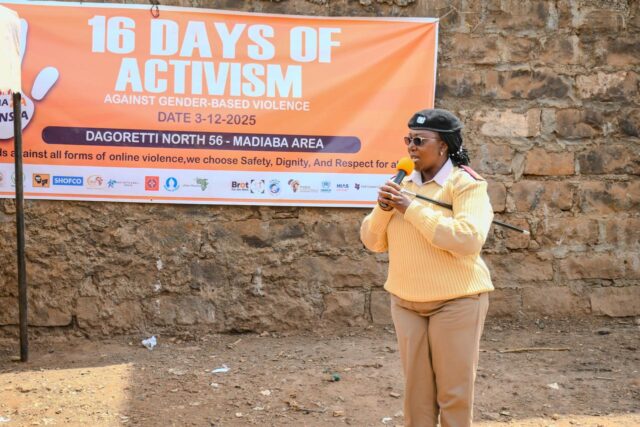
In Nairobi, we joined partners under the Kibera Gender Advocacy Network (KGAN) at the DC Grounds to launch the 2025 16 Days of Activism. The activation highlighted the rising threat of technology-facilitated gender-based violence, including online harassment, deepfakes, blackmail, and misinformation. During the engagement, CREAW showcased its comprehensive survivor-centered support, including access to free legal aid, psychosocial services, and sustained advocacy for safer and more accountable digital spaces.  

In Mombasa, CREAW joined partners under the County Gender-Based Violence Technical Working Group (GBV-TWG) at Tononoka to launch the 16 Days campaign, echoing the global theme, “Unite to End Digital Violence Against All Women and Girls,” and reinforcing the need for multi-sectoral collaboration to address both online and offline forms of violence. 

In Nyeri County, more than 100 girls and young mothers were sensitized on gender-based violence, teenage pregnancy, HIV/AIDS, drug and substance use, and mental health during the campaign launch. Together with county leaders and partners, CREAW reinforced a collective stand for action and accountability against violence. Addressing the participants, Nyeri MCA Hon. Agnes Wachira encouraged the girls to speak out and pursue empowerment through education and skills acquisition, affirming that, “You are not alone. You deserve dignity, safety, and justice. Your voice matters. Your dreams matter. Your life matters.” 

To amplify awareness, CREAW also joined Radio Maisha on the Staarabika show, where our lawyer Evelyn Apondi unpacked: How to identify digital violence, what survivors can do and how the law protects victims 

This conversation allowed thousands of listeners to better understand online safety and their digital rights. 

By centering digital violence within the broader fight against gender inequality, CREAW reaffirms its leadership in championing women’s rights and advancing a society where every woman and girl can thrive on the streets, in their homes and equally online. 


Victoria-Mumbua-Painting-Buildher-1.jpeg

December 6, 2025by CREAW


For as long as she can remember, Victoria Mumbua has always had an eye for detail, especially when it came to painted walls. She would notice the uneven strokes, the bumps, the cracks and silently think, “I could do better.” That quiet curiosity led her to Buildher, one of the partners under the Jasiri Program, which equips young women with hands-on skills to help them participate meaningfully in the world of work. At Buildher she is learning painting and decoration.

As a mother of two, Victoria juggles motherhood, studies, and an internship that runs six days a week. Her days begin at dawn and end after sunset leaving home at 6 a.m., attending classes from 8 a.m. to 5 p.m., then heading home to care for her children.

By the time she walks through the door, she’s exhausted. “Sometimes I feel like I’m losing touch with them,” she says quietly. “If someone told me one of them misbehaved, I wouldn’t even know whether to believe it or not.”

The demanding schedule has also strained her social life. But Victoria now sees that as a blessing. “Before Buildher, I didn’t know how to say no,” she admits. “Now I have boundaries. I know what matters.”

Through the Buildher’s training, Victoria is learning not only painting and decoration techniques but also discipline, financial literacy, and resilience. The program has given her access to trainers who challenge her to stay consistent, and to mental health support that helps her cope with the emotional toll of her journey.

Her sister occasionally helps her with food, rent, and school fees, but Victoria has learned to hold on to her bigger goal to complete her training and secure sustainable employment.

There are moments when she feels like giving up. “I’ve wanted to leave this program a million times,” she laughs. “Every week I say I’m done. But then wonder what would happen should I quit.”

She finds motivation in the women she meets at construction sites who tell her they earn Ksh 2,000 a day. “It reminds me that there’s something better waiting on the other side of this hard work,” she says.

Today, Victoria speaks with quiet confidence and determination. She’s learning to see beyond the struggles of the present to the promise of independence and stability ahead.

“I’m not just learning how to paint walls,” she says with a smile. “I’m learning how to rebuild my life.”


Nasimiyu.png

November 23, 2025by CREAW

Justin Nasimiyu, a mother and resident of Kibra, has walked a challenging path as a survivor of gender-based violence (GBV). Her journey is one of courage, reflection, and starting anew.

For years, Justin endured a painful marriage with a violent, alcoholic husband. He not only disregarded her feelings but also brought another woman into their home to humiliate her in front of their children. Justin faced daily beatings, insults, and was left to raise her children alone, as her husband support the needs of the family. “I lived through pain every day, but no one seemed to notice. I had to carry the burden alone,” she recalls quietly.

One day, Justin realized she couldnt continue living like that. After deep reflection, she made the brave decision to walk away and take her children with her. Leaving was not easy, but she knew she had to do it for herself and her children.

A close friend who witnessed Justin’s struggles introduced her to CREAW, where she was enrolled in the Jasiri Program. This connection transformed her life. Through Jasiri, Justin received counseling that helped her begin to heal from the emotional pain she had carried for so long. She also participated in financial literacy training, learning essential skills for managing her business. She was taught the importance of pursuing her passions, saving money for personal use, business, and emergencies, as well as keeping accurate records of every coin earned and spent.

“Before Jasiri, I didn’t know how to manage anything. I was just surviving, but they taught me how to plan for my life and my future,” she expresses.

After completing the training, Justin received a grant that enabled her to open her own salon business. From that moment on, her life started to improve. Today, Justin can comfortably pay school fees and provide food for her children, allowing her to support her family without the daily struggles that once weighed her down. “I now feel proud when I can meet my children’s needs without begging or waiting for someone to step in,” she says with a soft smile.

Justin is deeply grateful to Jasiri for giving her the opportunity to rebuild her life. “Jasiri came through for me in a way my friends and family could not. They helped me when I had no other way out,” she shares sincerely.

The difference between her past and present is stark; she has gone from days filled with pain and fear to days filled with hope and growth. She now has the strength to support her children even when they face challenges in school.

“To all the women going through the same thing, don’t sit in silence, waiting for friends or family to save you. Look within yourself and ask the hard questions. Staying too long in suffering can destroy you in the end,” she advises. Justin encourages women to share their stories and seek help from people and organizations that can genuinely support them.

Justin is thankful to Jasiri for pulling her out of a life of pain. She hopes Jasiri will continue to encourage and support her as she raises her children and builds her life.

The Jasiri Program aims to enhance the resilience of GBV survivors, increase their participation in economic opportunities, and shift social norms to create an enabling environment for them to thrive in the world of entrepreneurship and work. The program is implemented by a consortium comprising Centre for Rights Education and Awareness (CREAW), Grassroots Organizations Operating Together in Sisterhood (GROOTS Kenya), Collaborative Center for Gender and Development (CCGD), Centre for Domestic Training and Development (CDTD) and Advocates for Social Change Kenya (ADSOCK in partnership with the Mastercard Foundation. 


Screenshot-2025-09-29-163355.png

October 3, 2025by CREAW

Fifteen percent of adolescents in Kenya become pregnant before the age of 19, according to the Kenya Demographic and Health Survey (KDHS). The survey further shows that 59% of married and 42% of unmarried sexually active girls aged 15–19 do not use any form of contraception. These figures underscore the persistent barriers, ranging from misinformation and stigma to limited availability of youth-friendly services, that continue to deny young people their reproductive rights.

It is against this backdrop that CREAW, in partnership with Nairobi City County, Zamara Foundation, Joyworld Initiative, Tiko Africa, Hope Worldwide Kenya, Global Affairs Canada, CARE, and Forum Civ, convened a town hall meeting to mark World Contraceptive Day 2025, focusing on the realities of adolescents and young people.

“Adolescents and youth face the highest levels of unmet need for contraception, which often results in unintended pregnancies, disrupted education, and lost opportunities,” said Elizabeth Naini, Head of Nairobi County’s Adolescent Health Unit. “The biggest gap is lack of information, yet public facilities are youth-friendly and open for them to seek services.”

Faith leaders also weighed in on changing attitudes within religious spaces. Reverend Father Maximus Muchiri noted a shift within churches, saying, “Some religious institutions like mine actually run sessions teaching adolescents about contraceptives as a preventative approach. It is critical that these young people have access to accurate information.”

The town hall heard powerful testimonies from young people. A young father shared how lack of knowledge led to him becoming a parent immediately after high school, describing the experience as confusing and overwhelming. A teenage mother echoed his concerns, recounting how she became pregnant at 16 without knowledge of contraceptives and later faced stigma from her community.

Community leaders are also working to counter harmful beliefs. Nancy Wambui, Assistant Chief of Waithaka Location, said one persistent misconception is that contraception is only for married people. “This contributes to high rates of adolescent pregnancies. Many are also afraid to seek services due to stigma,” she explained, adding that youth-friendly centers are crucial in breaking these barriers.

The meeting also emphasized youth leadership in driving change. Veronica Komutho, CREAW Project Officer, urged young people to step up as community health promoters to ensure their voices are heard in both communities and policy spaces.

For Kenya, World Contraceptive Day remains a critical reminder that beyond access to contraceptives, there is a need to dismantle stigma, challenge harmful cultural and religious norms, and empower young people with accurate information. Without this, the cycle of unintended pregnancies will continue to undermine the education, health, and wellbeing of adolescents.

Watch the full town hall session here


MHM3-1280x853.jpeg

July 19, 2025by CREAW

Did you know? Over 500 million women and girls worldwide still lack safe menstrual products, costing billions in lost productivity, health, and opportunity.

This year, CREAW, in partnership with ForumCiv, commemorated Menstrual Hygiene Day 2025 in Mukuru, Nairobi.  Under the theme “Together for a #PeriodFriendlyWorld,” the event united adolescents from Makadara and Starehe, youth groups, and partners to dismantle period stigma, advance menstrual awareness, and foster inclusive spaces for women and girls. We joined the global movement to break the silence and stigma around menstrual health. Through our #PeriodEquity campaign, we raised awareness about the urgent need for accessible and dignified menstrual care.

CREAW reaffirms its commitment to ensuring periods never hinder health, education, or dignity.


MOU-signing-Morendat-2-1280x853.jpeg

May 14, 2025by CREAW
CREAW Executive Director Wangechi Wachira and KPC Managing Director Joe Sang during the signing of the MOU

In a timely move to economically empower marginalized, young female survivors of gender-based violence (GBV), the Centre for Rights Education and Awareness (CREAW), the KPC Foundation, and the Morendat Institute of Oil and Gas National Polytechnic (MIOG) have signed a four-year Memorandum of Understanding (MoU) to offer fully sponsored technical and vocational training to young women in Nairobi and Mombasa counties. 

The MoU outlines a shared commitment to provide technical skills training while also enhancing work-readiness through comprehensive coaching and mentorship, enabling their full participation in the economy and contributing to their long-term dignity and independence. The partnership also seeks to support the young women by securing internship placements for practical industry exposure and facilitating job linkages by tapping into existing industry networks. In addition, select beneficiaries will receive grants for entrepreneurship 

Speaking during the MoU signing ceremony, KPC MD Mr. Joe Sang noted that gender-based violence continues to rob young women of opportunities in economic participation. Without access to education and skills, many survivors face unemployment, economic exclusion, and generational cycles of poverty.  

“At KPC, we remain alive to these challenges and we remain steadfast in our endeavor to make a difference. In a bid to restore hope and confidence among survivors of GBV, KPC will fully sponsor globally accredited, hands-on training for the young women at our Morendat Institute of Oil and Gas (MIOG) polytechnic. The courses that will be offered under this MoU include: International Welders Certificate, Fiber Optic Installation Technician, Certificate in Motor Vehicle Diagnostics, Certificate in Electrical Installation, Forklift Operator Certification Course and International Fire Fighters Certification Course among others” he said.

The partnership is particularly significant for young women who are survivors of GBV, many of whom face economic exclusion, unemployment, and limited access to education. Studies show that GBV has profound consequences on women’s ability to participate in economic life often leading to lost productivity, job loss, and intergenerational poverty. By equipping survivors with technical skills and pathways to decent work, this initiative directly challenges the cycle of violence and economic vulnerability.

CREAW Executive Director Wangechi Wachira noted that this partnership will open up real opportunities for young women who are survivors of gender based violence to gain practical skills at the facility, find spaces to work, and build strong networks that can support their growth. 

“This isn’t just about skilling. It’s about restoring dignity, hope, and the belief that every young woman deserves a chance to live a meaningful and empowered life,” Wangechi said.

CREAW, through its Jasiri Program, will identify and support young women aged 18–35 who have either survived or are at risk of GBV. The KPC Foundation will leverage Kenya Pipeline Company’s national infrastructure and industry networks to support internship and employment opportunities. MIOG will provide globally accredited, hands-on training in high-demand fields including welding and fabrication, fibre optic installation, electrical installation, motor vehicle diagnostics, CNC machining, refrigeration and air conditioning, and fire safety.

Participants in Nairobi and Mombasa are encouraged to apply by clicking on this link. https://ee.kobotoolbox.org/x/jTbjPF8g


Screenshot-2025-04-08-at-15.15.03.png

April 8, 2025by CREAW
CREAW’s Executive Director addresses the stakeholders at the French Embassy

During the International Women’s month, CREAW showcased learnings on ‘Feminist funding for ‘Off The Tarmac’ women’s rights organisations(WROs) at the French Embassy. ‘Off the Tarmac’ refers to grassroots or non-mainstream women’s organizations that operate outside of formal, institutionalized frameworks. They work in remote, underserved, or conflict-affected areas where traditional infrastructure (legal, social, or economic) is limited.

They often have limited access to large-scale funding, rely on local resources and volunteers work with structures that are not formalized as such they are overlooked by mainstream development partners. Due to their proximity to the community, these organisations focus on marginalized groups, utilize intersectional approaches, and community driven focus.

Despite their ability to quickly respond to community needs and make sustainable change, WROs remain severely underfunded. They only receive a paltry 0.13% of Official Development Assistance(ODA) often given to mainstream organisations.

Identifying this gap, CREAW has, over the last 5 years, sub granted 41 ‘off the tarmac’ women’s rights organisations in 21 counties in partnership with Embassy of France, Global Affairs Canada, Hewlett Foundation, Mastecard Foundation and Embassy of Sweden. We have seen incredible growth of these WROs leading to deeper sustainable impact in the communities they serve.

The learning brief highlighted the key outcomes of our sub granting journey including derisking WROs, strengthening of their institutions, increased agency, enhanced collaborations and partnerships, digital transformation and tech enabled advocacy among others. 

The session challenged development partners, implementing partners and stakeholders to rethink feminist funding for grassroots WROs with the following recommendations: increase access to multi year, flexible core funding, simplify grant application and reporting requirements, strengthen capacity building and organisational development, promote digital inclusion and tech access, address socio cultural and political barriers, expand participatory and trust based grant making, expand local philanthropy and alternative financing options. 

We look forward to deepening the work we do while working with these critical organisations.


WhatsApp-Image-2025-04-07-at-12.53.00-PM.jpeg

April 8, 2025by CREAW
Community champion and child rights activist David Lupao

David Lupao, a children’s rights activist in Bungoma County, has witnessed firsthand how the dreams of young girls are cut short. After the COVID-19 pandemic, many girls were forced out of school and pushed into child labor, domestic work, and early motherhood. Young lives that were once filled with promise became entangled in challenges beyond their control.

David has always been passionate about protecting children’s rights, but his approach to creating change took a new direction after he was trained by CREAW in the Social Analysis and Action (SAA) model under the Imarisha Msichana project. The training opened his eyes to the root causes of teenage pregnancy and child marriage, revealing that these issues are not just about individual choices. The deeper problems lie in harmful social norms, cultural beliefs, and deeply ingrained community attitudes.

Together with other champions, David began engaging parents, local leaders, and schools in open discussions. Rather than blaming the girls, he encouraged the community to reflect on the gender norms that often shame teen mothers while ignoring the men responsible. Through community dialogues, parents and elders have started to question their beliefs about education, parenting, and gender roles. Schools have also begun to rethink their policies regarding teen mothers.

“For too long, we have condemned the girl and remained silent about the boy. If we truly want to end teenage pregnancy, we must address both sides of the problem,” David asserts.

David Lupao during a community engagement session

The Imarisha Msichana project is an initiative implemented by Forum for Women Educationalists Kenya Chapter (FAWEK) in partnership with CREAW and the Mastercard Foundation, that aims to significantly reduce the incidence of teenage pregnancy in Kenya during and beyond the COVID-19 crisis in 20 counties. One of its key interventions is to champion for school re-entry to teenagers and teen mothers.

David’s efforts are making a difference as more girls are returning to school, and families beginning to welcome them back home. The community is also changing its mindset, realizing that these girls need support, not shame.

Since the launch of the project in 2022, over 5,180 teen girls have successfully returned to school in the 20 counties with 245 girls in Bungoma county.

However, challenges remain; some families still struggle to accept their daughters, and many girls lack school fees, food, and other basic needs. David and the champions continue to advocate for change by urging parents to support their daughters, fight for justice against perpetrators, and lobby for stronger child protection policies.

“Change starts with us. Let’s shift our mindset, support our girls, and allow children to remain children,” David emphasizes.

Through his work, David is demonstrating that when a community changes its mindset, it can change the future for its children. And for the young girls of Bungoma, hope is on the rise.


Screenshot-2025-04-08-at-13.15.30.png

April 8, 2025by CREAW
CREAW team celebrates the launch of the revamped culture handbook

It is no secret that culture eats strategy for breakfast.

Which is why as CREAW celebrates 25 years, we proudly unveiled our revamped Culture Handbook—a reflection of who we are and where we’re headed. As we experience significant growth, we recognize the importance of staying agile and responsive to the needs of our team, stakeholders, and participants.

This renewed culture embodies our commitment to fostering a supportive, high-performing environment where everyone thrives while championing CREAW’s vision every day.

The revamped CREAW Culture Handbook has been designed to defines our identity, values, and way of working. It outlines key principles such as Synergy, Professionalism, Respect, Trust, and Integrity values that guide how we interact with each other, make decisions, and deliver our mission. As an organization committed to advancing gender equality and social justice, having a clear and intentional culture is important. This handbook ensures that all staff, participants and stakeholders understand what CREAW stands for and how we embody these values in their everyday work. By aligning our behaviors with these principles, we create a strong foundation that drives both individual and collective success.

At the heart of it all is our mission: to transform the lives of all women and girls by championing gender equality, rights, and social justice. We envision a just society where women and girls are valued, respected, enjoy full rights, and live in dignity.

Read our culture handbook here


Kilifi1-1280x911.jpg

December 10, 2024by CREAW

As part of the 16 Days of Activism against Gender-Based Violence (GBV), CREAW proudly participated in the launch of the Kilifi County Anti-Gender-Based Violence Policy (2024-2028). The event, held on November 25, 2024, at the Tezo Agricultural Grounds, marked a significant milestone in the fight to end GBV in the county.

The launch brought together a broad spectrum of stakeholders, including Kilifi Deputy Governor, County Executive Committee Member (CEC) for Gender, other senior county officials, development partners, implementing agencies, community stakeholders, and members of the public.

At the heart of this event was the unveiling of a policy designed to drive change. The Kilifi County Anti-GBV Policy lays out a clear and actionable framework aimed at addressing and eliminating GBV through multisectoral approaches, prevention strategies, survivor support systems, and accountability mechanisms.

Speaking at the event, Pauline Muigai, CREAW’s Program Officer in Kilifi, commended the strong collaboration between the Kilifi County Government and the State Department for Gender. She highlighted the progress achieved through these partnerships and reaffirmed the need for sustained joint efforts to eradicate GBV in the region.

Dr. Ruth Dama Masha, the County Executive Committee Member for Gender, emphasized the importance of partnership among all gender stakeholders saying, “Counselors, government departments, community organizations—we need your voices, your hands, your dedication. Together, we must ensure every resident understands this policy and sees its impact.”

Her Excellency, Deputy Governor Flora Mbetsa Chile, reiterated the county administration’s unwavering commitment to ending GBV. She called on all stakeholders to continue working together to foster a safer and more equitable society for all residents of Kilifi County.

The launch of this policy underscores CREAW’s dedication to supporting county governments in the fight against violence toward women and girls. Kilifi County now joins other counties—Meru, Narok, Nyeri, Nairobi, and Kitui—where CREAW in partnership with UN Women has played a pivotal role in developing gender-responsive policies.