Blog Archives - Page 11 of 13 - CREAW KENYA


February 7, 2019by CREAW0

“I had a vision to be a member of the County Assembly of Meru not because of the money but because I had mission to take the women agenda forward.”
These are the words of Lucy Mukaria the chairperson of the Meru Women Legislative Association (MEWOLA) who believes that leadership is about goals and the ideals of the community. She says that despite the societal barriers, women must rise up and take up leadership positions; be it elective or appointive.

As a young widow, she deserted her in laws and matrimonial properties taken away and left without any support. She was left without a penny to fend for her three children. What was so agonising to her was the cultural stigmatisation that widows went through in the village; they are taken as outcasts.
“When I started living as a single woman and with no much support, the thought of the other widows crossed my mind. What about the single mothers that were not working? What about women in the community whose lands are taken away by the elders or clan and never made to be part of the decision regarding the community or their families? I asked myself why women aren’t getting opportunities like men? ” She explains while noting that the disparities are as a result of the imbalanced power relations.

In Meru County where Mukaria ails from, women are disadvantaged when it comes to land ownership. This is despite the progressive and robust legal frameworks on land ownership in Kenya; a clear indication on the of the non-balanced power dynamics and cultural inequality when it comes to land allocations between men and women. This inequalities are also transited to the political governance even at the village level up to the highest governance levels.
“These experiences however put me at a better place in understanding the challenges women go through. All these are not ‘women issues’ but societal issues,” she says.
For Mukaria, the Constitution of Kenya 2010 was a game changer towards the right direction. Its provisions on the two-thirds gender principle was a step forward in pushing the equality agenda which for a long time has been underpinned by patriarchal systems where political engagement has for a long time been dominated by men.

Her leadership journey has been on the glimmer for decades; she started off her career in the civil society but the climax she says is when she got involved in the The Katiba Sasa! Campaign during the clamour for the CoK 2010. The campaign advocated for the speedy enactment of the constitution to ensure a free governance space. This placed her at a position to engage with the governance system and penetrate through the party structure.
As a figure that was now well known and recognised in the civil society as well as the grassroots political arenas, she got elected to be the Councillor of the then Meru Municipal Council in the old constitutional order.
“I made a name out of the campaigns. I was known for social justice but I wanted more than just the connotation of ‘flower girls’ for women leaders. Coming into the County Assembly of Meru in 2017, she galvanised the support of other 23 women to form a caucus that would ensure that the operations and policies enacted by the County Assembly are engendered,” says Mukaria.
She adds: “As women we must know how to manoeuvre through political spaces, for me one of the best strategy I ever made in during the 2017 general elections was to align myself with a political party. I got to understand what how the political party systems work. I made male politicians my alias and even though I lost in the elections, I was specially elected to sit at the Assembly based on my track record.”
With the technical support from CREAW through the Wajibu Wetu project, Mukaria and other female MCAs under the banner of the MEWOLA developed a Strategic Plan with an aim to champion and advocate for gender sensitive policies at the county level.
Through the MEWOLA, the MCAs will continuously advocate for stronger women movements to champion for equality in development processes


January 25, 2019by CREAW0

Beatrice Charo confidently walks as she approaches us, with a fruity voice and a smile that paints a ray of sunshine allover her face, she greets us and ushers us in towards her living room. Here, she speaks passionately about the community she had called home for decades. It is here in the coastline town of Malindi that she had started her teaching career.

Beatrice Charo. PHOTO: CREAW

With the beautiful beaches that stretch across the horizons of the dark blue waves ocean; a picture is painted of a land at peace with itself yet down the sandy beaches, the cries of young girls making life in the twilight becomes just a whisper, and as Charo puts it, many girls are forced to drop out of school as a result of child exploitation that exposes them to sexual violence, early and forced marriages and child pregnancies.
“Often girls are forced into marital roles when their families betroth them as a trade off to ease poverty. These girls are forced to abandon their education and instead transition to fulfill the duties of wife and mothers,” she explains, noting that this limits girls’ ability to earn income and build sustainable earnings that will lift their families out of poverty and so the cycle of destitution in the family chain becomes limitless.
She says these limitless challenges that the girls face in the community also mirrors in their school performance vis-a-vis boys. Therefore, it is imperative that these learning environments must always be safe and gender inclusive to nurture a sense of responsibility and respect among boys and girls.
At Kibokoni Primary School where she teaches, she has made it her personal cause to ensure that girls are retained in school and that they enjoy safer learning environment free from any exploitation. She credits it to the knowledge that she acquired from several training sessions organized by CREAW for teachers in Kilifi County. In the trainings, teachers are trained on the aspects of gender-based violence (GBV), positive ways to discipline children and the rights and responsibilities pertaining to child protection.
“Every Wednesday, we have a forum where we sit with the girls to listen to the challenges they experience in and around school. This encourages them to speak up to avert severity of psychosocial issues and build on their self confidence,” she says.
Charo however is not alone in the anti-GBV war in schools; Getrude Karisa a teacher at the nearby Upewoni Primary School is elated that by virtue of being teachers, they have the opportunity and responsibility to nurture the voices of school going children under their care to be able to speak out on GBV. Both Charo and Karisa are members of the Beacon Teacher Movement.
The Beacon Teacher Movement is an initiative of the Teachers Service Commission that was initiated to give teachers the opportunity to promote child protection in their schools and communities. The teachers are trained to create awareness of child rights and responsibilities among learners and what to do when they are abused.
Karisa’s major concern is the numerous night Disco matangas- night vigil dances around Malindi attended by men, women and children to dance the night away in celebration of the deceased. Beneath the celebrations, men prey on young girls.
Kilifi has been cited as one of the counties with high prevalence of teenage pregnancies conceived mostly at the local disco matangas. According to the Ministry of Health (MOH) 22 percent of girls aged between 15 and 19 in Kilifi County have began child bearing which is higher than the national statistics which stands at 18 percent.
“A week cannot go by without the night vigils. Many girls are defiled and some end up being pregnant and infected with sexually transmitted diseases in the process,” says Karisa.
She notes that communities must now move away from the popularisation of night vigils, which are unsafe to their daughters. They must have candid conversations on how to protect children. She recalls of a recent incident where a 16-year-old girl who schools at Upewoni was defiled by 18 year old in a disco matanga and the families were unwilling to talk about it or report the issue to the police.
How then does she handle such matters?
“I noticed the girl was pretty much disturbed and unusually quiet while in class. I called her aside and we talked at length, she opened up. We reported the case to the police. The matter is now in court,” Karisa says.
In Kilifi, the County Government issued a directive that banned disco matangas citing the rise in cases of sexual abuse and HIV infections among minors. Despite that night vigils still continues under the watch of local administration officials who collude with communities.
Both Kibokoni and Upewoni Primary schools have speak-out boxes installed in key locations that pupils post their issues. During the monthly parents meeting, the teachers are given an opportunity to educate parents on child protection and to handle GBV incidences when they arise.
Karisa’s main motivation lies with the fact that her parents gave her the opportunity to go to school despite the cultural conservatism on girls’ education among the coastal communities.
“I would not be where I am if I was not empowered through education. I have to ensure all the other girls also get to experience what it means to ascend through education and become responsible adults,” says Karisa.


June 10, 2018by CREAW0

May 24 2018, marked the beginning of a new milestone with a rather conversational and a very informative two-day colloquium for the Meru County Judges, Magistrates and other judicial officers.
The conversations on harnessing an effective and efficient judiciary in handling sexual and gender based violence (SGBV) matters had shifted to the county level, in this case; Meru County.
The Center for Rights Education and Awareness (CREAW) in collaboration with the Judiciary organized discussion to sensitize judges, magistrates and other judicial officers on Court decisions that have set precedents in determining SGBV cases with the theme: “Harnessing the emerging jurisprudence through best judicial practices, innovation and local remedies.” The judicial officers were keen to dissect the rampant cases of sexual violence against children in the county.

Speaking at the inaugural session of the colloquium in Meru, Justice Anne Ongijo noted the difficulty in handling cases where minors come into conflict with the law. She observed that when it comes to the criminal justice system in Kenya the courts are put in a predicament where there are not able to determine which of the minor to bring to book and as such; It is still a grey area that is currently been handled by putting both minors under protection and care through the children department or probation office.
“There is need to amend the Sexual Offences Act to effect that where a sexual offence has been committed between two minors, none of them should be charged in the court of law. It is a matter that should be dealt with in the community. Minors should be well educated on the dangers of premarital sex,” notes Justice Ongijo.
Justice Ongijo also delve into the infamous ruling issued by Judge Said Chitembwe who freed a 24 year old man convicted of defiling a minor. Chitembwe who served as the Malindi Court judge then, failed to convict the accused person, arguing that the minor behaved in a manner likely to suggest she was an adult.
“Such rulings sets bad precedents for our justice system and exposes minors to further violations,” she adds.
Under the Sexual Offences Act, a child below the age of 18 years cannot give consent to sexual intercourse and therefore, all intimacy with children, willing or not, is defilement.
Muthomi Thiankolu of Muthomi and Karanja Advocates however noted a landmark ruling by High Court in Meru where a group of young girls successfully challenged the government on its inaction regarding sexual violence against children.
“The case is commonly referred to as the “160 girls case.” The petitioners in this case were majorly girls who had been defiled on diverse dates by a teacher. When they reported the matter to police, their case was mismanaged; the police were not willing to record statements or do proper investigations,” narrated Thiankolu.
Thiankolu who was the lead advocate in the case say when the matter went before the High Court in Meru, the judge ruled in favour of the girls, ordering the police to conduct prompt and effective investigations into each girls’ cases as well as take measures to fulfill their constitutional duties to comply with human rights standards in all cases of defilement.
“This case made a legal history in Kenya and globally as it brought to light the plight that many survivors of sexual violence have to endure before perpetrators are finally brought to book. This is a classic case that depicts the importance of strategic litigation in the society,” says Thiankolu.
Over the past few months there has been a wave of storm of sexual violence in school majority to which are committed by teachers who are supposed to be the custodians of learners while in school “loco parentis”.
In 2017, the Teachers Service Commission (TSC) struck off 71 male teachers for misconduct. In 2016, 22 teachers who had sexual relations with their students were banned from ever teaching in Kenya while in 2015, another 126 teachers were deregistered.

In the wake of this, the Teachers Service Commission (TSC) said that principals would now be held accountable for the safety of learners in schools. But that is not enough; according to the teachers who spoke at this year’s annual head teachers conference in Mombasa, there is need for the installation of surveillance cameras in schools as well as the employment of former military officers to boost security and curb sexual violence in schools.
In the courtrooms however, judges and magistrates are concerned of the emerging incidences where teachers stand as sureties to colleagues who commit sexual offences. It is such that has opened the gates court petitions against TSC for the failure to provide safe school environments and thereby exposing learners to SGBV but also the risk of being infected with HIV/AIDS.
One such public interest litigations was one spearheaded by CREAW and litigated by John Chigiti of Chigiti and Chigiti Advocates. This case brought to light the plight of students in the hands of their amorous teachers. In this, TSC were ordered by the court to put in mechanism to prevent and effectively respond to G.B.V violations with the intent of protecting learners in school.
“TSC cannot shuffle paedophiles from one school to another, and finally, content itself with dismissals. It has to put in place an effective mechanism, whether through an inspectorate department within TSC or the Quality Assurance Department within the Ministry, to ensure that no-one with the propensity to abuse children is ever given the opportunity to do so. Dismissal, and even prosecution, while important, can never restore the children’s lost innocence,” read the judgment delivered by Justice Mumbi Ngugi in 2015.


April 6, 2018by CREAW0

Asenath Kaimuri says when women combine their efforts, the impacts and contribution towards policy and legislative development is more extensive than individual efforts.
This is in reference to the newly formed Meru County women caucus aimed at championing for the inclusion of women in political governance and development processes.
“We operate in an environment that does not accord women a space to participate in the governance and political processes despite the right to equal representation from both genders having been enshrined in the Constitution. I knew the only way to make our voices louder in the County Assembly is to have all women legislators working together with a common goal to push the women agenda,” says Kaimuri.

Kaimuri is the chairperson for the Meru Women Legislative Association (MEWOLA); a caucus of women legislators at the County Assembly of Meru formed to chat the path for the women agenda owing to the cultural challenges that underpins political representation in the County.
The Caucus is headed by a secrteriate that includes, the Chairperson, Vice Chair, Secretary, Assistant Secretary, Treasurer.
During the 2017 general elections, only two women were directly elected to the County Assembly of Meru. 21 members were nominated by the various political parties to fill in the gender threshold as per the Constitutional provisions of the two-thirds gender principle.
“Most elected MCAs are men and they feel they have more rights than the women when it comes to appointment in the House committees. At first none of the women were elected to chair the committees but after push and pull from the women legislators, only one was given a slot to chair the County Cohesion and Devolved Unit Committee,” she says.

“The Committee positions were politicized as well. The criteria used was regionalized based on the Wards which only factored the male membership in the Assembly leaving out of the key policy decision making processes,” adds Kaimuri noting that the environment for women leadership has since changed.
That did not however deter them from pushing forward to have their voices heard. Their persistence garnered then positions as the vice chair of the house committees…name them.
Today the MEWOLA is in the process of drafting a strategic plan that would guide their operations in the coming five years. Key among the strategic focus is the enactment of the Meru County Sexual and Gender Based Violence policy for an effective prevention and response of GBV and create budgets that are gender sensitive.
“We aspire to create strategic partnerships wit state and non-state actors to ensure gender issues are mainstreamed in the county.” She explains.
In the last County Integrated Development Plan, gender issues were not well articulated posing a challenge to the implementation of projects that adhere to the issues of inclusivity including people living with disability.
For decades CREAW has been working to equip women with the knowledge to be able to challenge societal norms that underpins their ascension to appointive and elective positions. With the knowledge, the women gain the confidence to engage with key decision makers on accountability issues on the rights of women and girls. Through that; they are also able to vie and get elected into the county and national assembly and able to influence key policies that enables for the actualization of the inclusion of women in the development processes as well us address the scourge of gender based violence in the communities.


Women-Protest-1280x764.jpg

January 25, 2018by CREAW0

By Christine Ogutu

With the new Constitutional dispensation in 2010, the women of Kenya were hopeful of a new beginning that would enable them participate in the democratic governance of the country.

The Constitution of Kenya 2010 created avenues necessitating an affirmative action aimed at reducing gender imbalances in leadership positions. Article 26 (6), 27 (8) and 81(b) postulates that not more than two-thirds of the members of any elective or appointive positions shall be of the same gender.

Seven years down the line, the provisions of the Constitution are yet to be met. Women representation in public bodies and Parliament remains minimal owing to the lack of political good will in providing legislative mechanisms for the realization of the two-thirds gender principle.
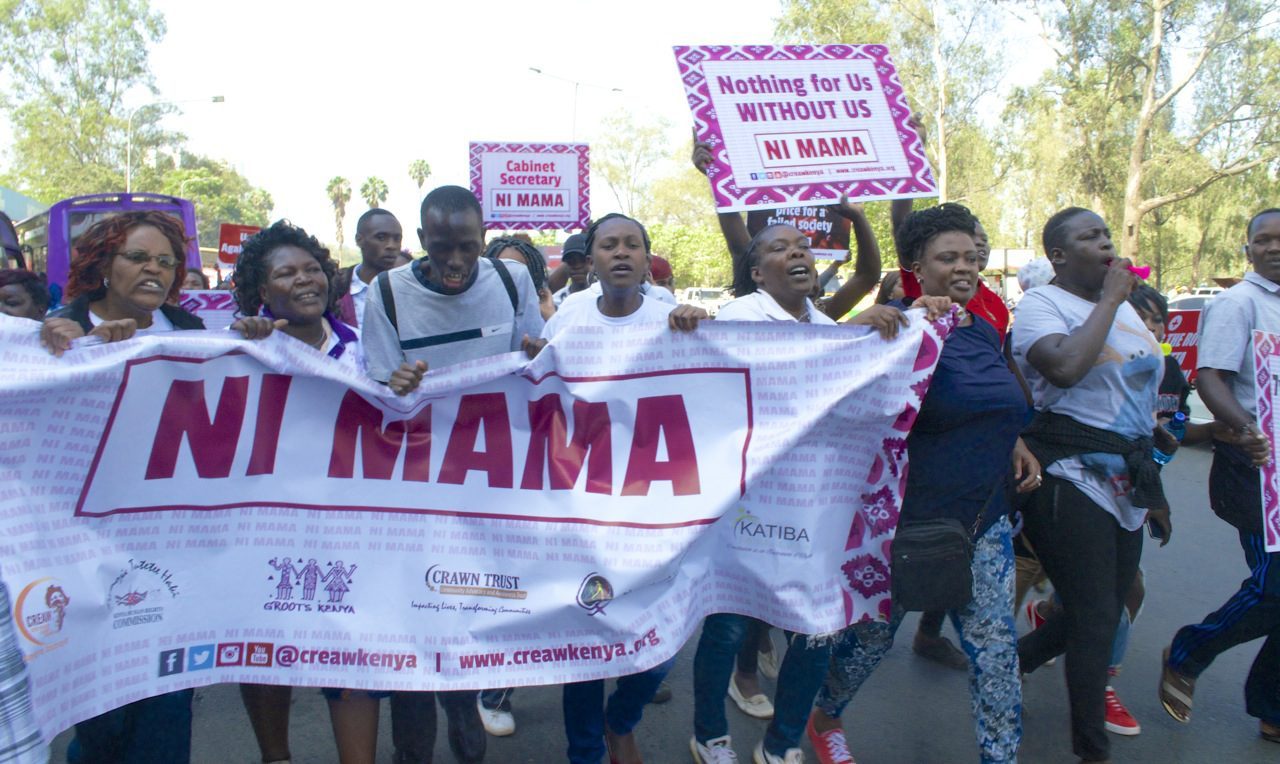
“ For too long, the women of Kenya have been intentionally excluded from decision making processes, deliberately denied the right to be fully represented in Parliament and constantly overlooked with regards to positions of appointment to public office,” said the women in a statement delivered to the Office of the President during a march on January 22 along the streets of Nairobi.
The women who were joined by CREAW, FEMNET, Groots Kenya, Katiba Institute, Kenya Human Rights Commission and the Women Empowerment Link among other concerned rights groups and Kenyans of goodwill took to the streets in protest of the continued discrimination and exclusion of women from the governance processes.
The women stated that “whereas it is clear in Law and Courts decisions that there can not be more than two-thirds of any gender in elective and appointive positions, the principle has not been adhered to in Parliament nor has it been given any consideration in the ongoing appointments of the Cabinet.”
Currently there are 76 women in the National Assembly, which is 41 short of the required number. In the Senate, there are 21 female senators, which is also two short of the required number resulting into an improperly constituted parliament as per the Constitution.
“We find it unconscionable, disrespectful and an affront to the women, that more than 7 years since the promulgation of the Constitution, women are still forced to agitate for their right to political participation and equitable representation in Parliament and in the Executive,” read the statement in part.
Recently in his first batch of nominees to Cabinet, the President dropped all women in his earlier Cabinet, naming only men. This, women said is a dishonor to the gains made by the women movement since independence.
“The President, Parliament and Political class must stop sacrificing women for political expediency and wake up to the realization that women remain vigilant and will continue to seek accountability for the implementation of the Constitution,” said Beatrice Kamau who read the statement on behalf of the women.
She added: “The remaining appointments to the Cabinet must therefore be made with uttermost regard to the principle of the not more than two-thirds as enshrined in the Constitution and fulfill the directives of the Court which also found the previous Cabinet to be unconstitutional.”
In the march, the women sought to remind Parliament of its duty as a legislative body to enact the necessary legislations for the actualization of the two-thirds principle. This they say will bridge the gaps that have for a long time denied women their spaces at the decision-making tables.
In march, the women also petitioned the Inspector General of the Police, Joseph Boinet to speed up investigations on the alleged sexual violence against nursing mothers at the Kenyatta National Hospital(KNH) and bring perpetrators to book.

“KNH is an institution in a position of authority and trust and therefore owes a duty of care to its patients. It therefore follows that the administration should have systems and structures that protects vulnerable patients and responds to any acts or omissions that breach the duty of care,” read the petition.

The concerned women of Kenya said that it was insensitive and unethical for the hospital administration to casually deny the claims of sexual assault as no survivor had come forward to report any of such cases.

“It is not enough for the Cabinet Secretary of Health Cleopa Mailu to order for investigations without himself visiting the hospital to ascertain the veracity of the allegations and satisfy himself that all the measures are being taken by the hospital to secure the safety of patients and  ensure full cooperation of hospital staff in bringing forward evidence concerning the allegations,” said the women.

KEWOPA-2.jpg

January 15, 2018by CREAW0

By Christine Ogutu

Women legislators on Friday 12th January converged in Naivasha for an induction workshop.
The three day event aimed at “laying the foundation for an effective female legislator” was organized by the Kenya Women Parliamentary Association (KEWOPA) in partnership with the Center for Rights, Education and Awareness (CREAW), UNWomen, USAID and FIDA among other key actors in gender and governance.
Speaking at the event, the outgoing chairperson of KEWOPA Cecil Mbarire lauded the gains made by women MPs in the previous parliament in actualizing legislative processes. She called on the leaders to be proactive in building communities.
In the 11th Parliament, women contributed tremendously to the enactment of family and gender based violence legislations. These are: Matrimonial Property Act, Marriage Act, Protection Against Domestic Violence Act, and Prohibition of Female Genital Mutilation Act.
“We have numbers in parliament to achieve our goals. We need to stay focused and chat the way forward for the women agenda,” said Mbarire who served as the chair of KEWOPA in the 11th Parliament.
“Let us capacity build women to be effective leaders,” she added.
The Cabinet Secretary for Public Service, Youth and Gender Affairs Sicily Kariuki congratulated the legislators for making it to the National Assembly and Senate noting that the country has beaten many odds in terms of women representation in key decision-making spaces especially in Parliament.
“The gradual increase in the number of women in all arms of government is as a result of consistent and tireless efforts of our path finders whose shoulders we stand on,” she noted, explaining that it was important that the female legislators understood the history of women empowerment so that they soldier forward with full appreciation of those who came before them.
In the quest to ensure gender balance in all elective and appointive positions, Mrs Kariuki challenged the MPs to ensure the country attains and upholds the two-third gender principle within their oversight and legislative roles.
It is the first time since the dispensation of the Constitution of Kenya 2010 that three women were elected as governors in an election that also saw three women senators and 23 women MPs elected to the 11th Parliament; a great milestone in the push for gender equality and women empowerment.
“There is need to ensure both the national and county governments allocated enough resources to prevent and respond to gender based violence,” she said, adding that “we need to advocate and legislate for resources to end all forms of GBV and keep our girls in school.”
Her sentiments were also echoed by the former Gichugu MP Martha Karua who reiterated the need for male engagement in advocacies around gender imbalances in governance.
“When you contextualize gender within the family, it becomes very easy to convince men on our courses. In this, even the worst critics of gender inclusivity become your partners,” Karua said.
Karua who expressed optimism in the ability of women voices in parliament, explained that women have the responsibility to steer the country to prosperity if they speak with one voice even out of parliament.
“Most political parties have not met the Constitution merit on gender; you need to speak out on such inequalities,” she said.
During the induction, Kirinyaga Woman Representative Wangui Ngirici was elected the KEWOPA chairperson taking over from Mbarire. Also elected to lead the Association are the Kisumu Women Representative Roza Buyu as vice chairperson in the National Assembly and nominated Senator Milicent Omanga, vice chairperson in the senate.


May 25, 2017by CREAW0

In a colourful ceremony Centre for Rights Education and Awareness launched the Haki Yetu Jukumu Letu Project at the Baobab Hotel Kilifi.
The project is a 3 year grant that seeks to ensure that the women and girls in Kilifi county are better able to exercise their rights as enshrined in the constitution.
In attendance were KAYA elders and other duty bearers.

Haki Yetu Jukumu Letu project launch in Kilifi


May 19, 2017by CREAW0

Centre for Rights Education and Awareness this morning Friday 19th May 2017 in a colourful event launched the Haki Yetu Jukumu Letu project in Meru County. The project is a 3 year Gender Based Violence intervention that seeks to address the high incidences of Gender Based Violence in Meru. The chief guest at the event was Hon. Peter Munya the Governor of the county Government of Meru. Hon. Justice Gikonyo of the High Court of Meru, Hon. Florence Kajuju the Women Representative Meru county amongst other dignitaries.
The project was officially launched by H.E Hon. Peter Munya Governor of the County Government of Meru. Speaking at the launch, he said he was committed to working with CREAW and other stakeholders to ensure the issues of Gender Based Violence were addressed and would push the county assembly to enact a county specific Gender policy.

Haki Yetu Jukumu Letu project Launch in Meru County