
Last month, I wrote an article about the women I met in Kilifi and what their stories taught me about economic independence and recovery from gender-based violence (GBV). I have kept thinking about one question since then: what happens to the survivor who needs this kind of support but cannot access it? For many survivors, the barriers are very immediate.
She may know that she needs to leave an abusive situation, but have nowhere safe to go. She may need to get to a hospital, police station or court, but not have money for transport. She may need to relocate with her children, but have no money for rent or basic necessities. She may want to rebuild her livelihood, but have no capital to start. These are not small gaps. They can determine whether a survivor is able to leave, seek help and begin rebuilding her life or remains trapped in an abusive environment.
This is why I believe Kenya needs to seriously consider a dedicated GBV Survivor Fund. A Survivor Fund would provide financial support to survivors at the moments when economic circumstances make it hardest to access safety, justice and recovery. It would complement the medical, psychosocial and legal services that already exist, while addressing a gap that is often overlooked: the cost of actually getting from crisis to safety and, eventually, to independence.
So, what should a Survivor Fund look like?
- It should help remove economic barriers to safety.
At its heart, the fund should give survivors the ability to make choices without being constrained by financial dependency. This could include emergency vouchers and relief grants to help with food, temporary housing and transport when a survivor is in immediate need.
2. It should make safe relocation possible.
For some survivors, staying safe means leaving their current abusive environment. A Survivor Fund should therefore provide support for safe relocation, including emergency accommodation, rent subsidies, child support and resettlement packages.
3. It should strengthen the systems survivors rely on.
A survivor’s journey rarely involves just one service. She may need a hospital, psychosocial support, police station, a shelter, and legal assistance, sometimes all within a short period of time.
The fund should therefore strengthen referral pathways and support coordination between hospitals, police, legal aid providers, shelters, county gender departments and organisations working directly with survivors.
The goal should be a response that works around the survivor, rather than making the survivor move from one disconnected system to another.
4. It should support access to justice.
Seeking justice can come with costs that are easy to overlook. Transport, medical and forensic services & documentation, or even legal assistance. A survivor should not be forced to abandon the pursuit of justice because she cannot afford the practical costs involved.
5. It should support women to rebuild their economic lives.
This is perhaps one of the clearest lessons from the women I met in Kilifi. Economic empowerment gives women choices. The fund could provide economic empowerment grants for small businesses, vocational training and skills development, depending on the survivor’s circumstances and aspirations.
The goal is not simply to provide a one-off handout. It is to help women move from crisis towards stability and, ultimately, greater independence.
But establishing a Survivor Fund is not just about deciding what to pay for. We also need to think carefully about the needs and the voices of women and girls in how the fund is designed, managed and delivered.
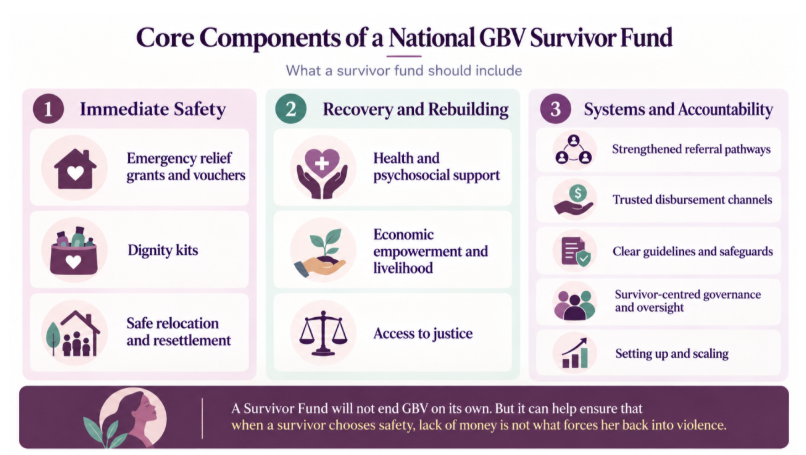
Here are the core components of a survivor fund
Emergency relief vouchers & grants: Short-term financial support for food, temporary accommodation and transport to provide immediate assistance during crisis.
Dignity kits: Essential personal and hygiene items to support survivors during crisis and recovery.
Safe relocation and resettlement: This should include emergency housing and temporary accommodation, rent subsidies and relocation packages. It is critical to also have support for children accompanying survivors.
Economic empowerment and livelihoods: Grants for starting or rebuilding small businesses, vocational training and skills development. This will provide livelihood support to strengthen long-term economic independence.
Health and psychosocial support: Medical and forensic costs, counselling, psychosocial support and other essential health-related services.
Access to justice: Fund should provide legal assistance, transport to access justice services as well as documentation and related costs.
Strengthened referral pathways: Support coordination between hospitals, police, legal aid providers, shelters and county gender departments.
Trusted disbursement channels: Delivery through certified civil society organisations, safe houses, financial institutions and county gender departments. There should be clear, safe and survivor-centred mechanisms for accessing funds.
Clear guidelines and safeguards: Ensure dignity, confidentiality and non-discrimination while also establishing transparent criteria for accessing and managing the fund.
Survivor-centred governance and oversight: A multi-sectoral steering mechanism bringing together government, women’s rights organisations, service providers and survivor advocates.
Setting up the Fund and scaling: The government to set up the fund through shelters, WROs and legal aid providers then document lessons and evidence before scaling nationally.
A Survivor Fund will not end GBV on its own. But it can help ensure that when a survivor chooses safety, the lack of money is not what forces her back into violence.