
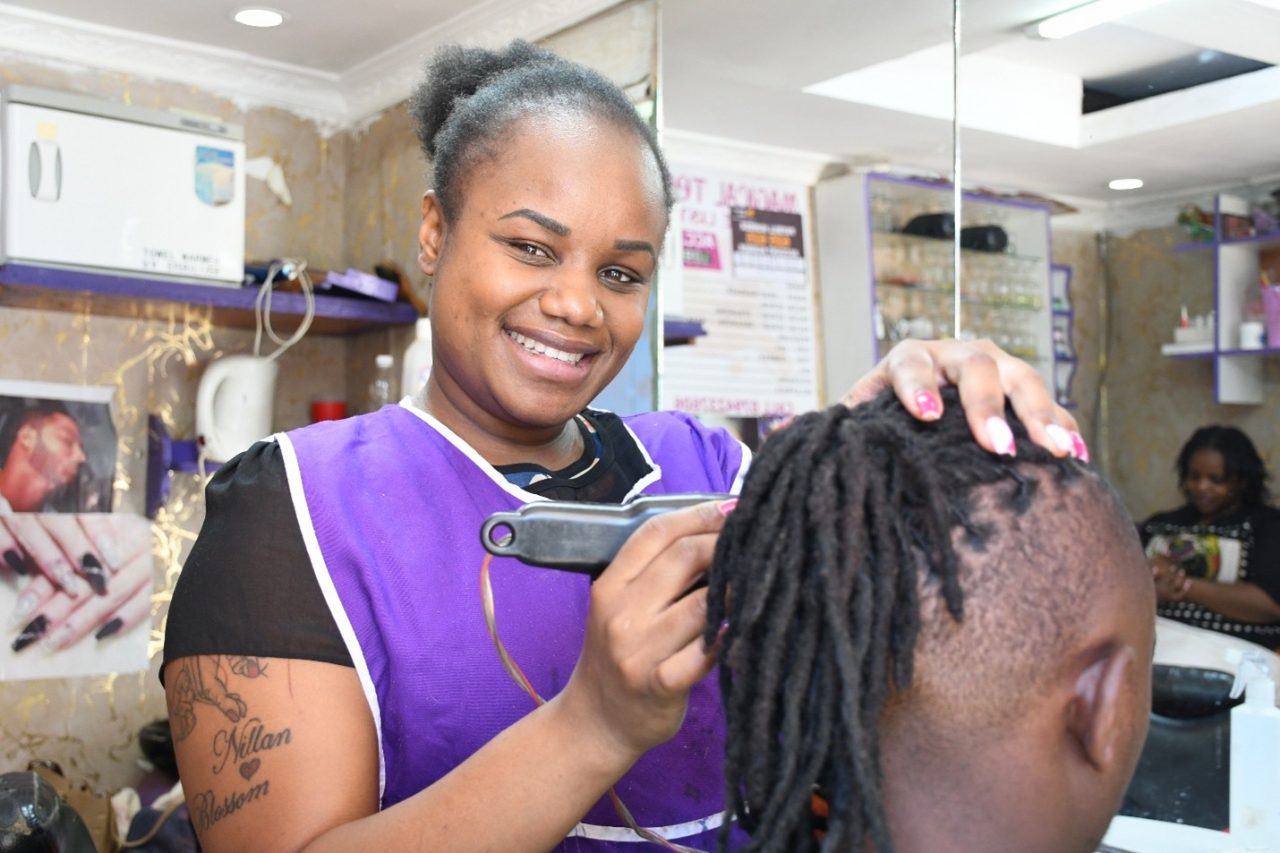
Just a few years ago, Jacinta Kihara could never have imagined owning a thriving beauty business in Nyeri. At 29 years old, she was trapped in a vicious cycle struggling to provide even the most basic necessities for her children. Today, she proudly runs her own nail spa, employs two people, and is steadily growing a business that has restored her dignity and given her family a brighter future.
Before joining the Jasiri Program life was incredibly difficult. Providing food for her children was a daily struggle, buying diapers felt like an impossible luxury, and paying school fees was a constant source of stress. To survive, Jacinta relied on casual labour. She washed clothes in other people’s homes, cleaned houses, and occasionally found work on farms, earning just enough to put food on the table for that day.
Everything began to change after a friend referred her to CREAW. The friend, who had also survived violence, shared how counselling at the organization had helped her stand again on her on. Encouraged by this testimony, Jacinta sought help. Her first step was counselling, where she received psychosocial support that helped her begin healing from the challenges she had experienced. The sessions restored her confidence and prepared her for the next phase of her journey.
Although she already possessed basic nail care skills and had saved a small amount of money from occasionally offering nail services in other salons, she lacked the capital and financial management skills needed to establish her own business. Through the program Jacinta participated in business and financial literacy training before receiving a business grant of KSh 25,000.
The training transformed the way she viewed entrepreneurship. For the first time, she learned the importance of budgeting every shilling before spending it. She was taught how to separate business money from personal expenses, allocate funds for rent, stock, staff salaries and savings, and maintain financial discipline. She also understood that saving consistently is essential for business growth and for preparing for emergencies.
Using the grant strategically, Jacinta carefully budgeted every expense. She first paid KSh 5,000 for business rent before purchasing salon equipment, including machines, chairs and essential supplies. Because of the financial literacy skills she had gained, every shilling was accounted for, allowing her to establish her salon without wasting resources.
Starting the business was not easy. For the first four months, she managed the salon completely on her own. As her client base gradually expanded, she hired her first employee. Three months later, she brought on a second staff member to meet the growing demand.
Today, Jacinta’s business continues to grow steadily. Having additional staff has enabled her to serve more clients without turning anyone away, increasing both customer satisfaction and business income.
The impact extends far beyond the business itself. Jacinta can comfortably buy food for her family, purchase necessities such as diapers without worry, pay school fees on time, settle household bills, and even set aside savings for emergencies. What was once a daily struggle for survival has become a life of stability, confidence, and hope.
“Before, I survived through casual jobs washing clothes, cleaning houses, or working on farms just to feed my children. Today, I own my own nail spa, employ two people, and can comfortably provide for my family.”
“The financial literacy training completely changed how I manage money. I now budget for rent, stock, salaries, savings, and emergencies. Because of that discipline, my business continues to grow every day.”
By combining psychosocial counselling, business training, financial literacy, and start-up capital, the Jasiri Program equipped her with both the confidence and the practical skills needed to build a sustainable livelihood.
The Jasiri Program is a five-year (2023–2028) initiative designed to strengthen the resilience of GBV survivors, expand their access to economic opportunities, and shift social norms so adolescent girls and young women (AGYW) can thrive in entrepreneurship and employment. Implemented across 16 counties in Kenya, the program is delivered by a consortium comprising the Centre for Rights Education and Awareness (CREAW), GROOTS Kenya, the Collaborative Centre for Gender and Development (CCGD), the Centre for Domestic Training and Development (CDTD), and Advocates for Social Change Kenya (ADSOCK), in partnership with Mastercard Foundation.